
Educators need agency, not just new rules
AI is making student learning invisible to teachers. And it’s turning teachers into someone students look past rather than someone they go to. What if teachers could regain their sightlines by doing something they already know how to do — talking to their students?
Drawing on a nationally representative survey of more than 1,000 US public school teachers and principals, plus interviews with educators and 31 young people, this report examines how generative AI is reshaping relationships in classrooms, and offers five free plays to help educators move from AI refs to AI coaches.
By Beck Tench, Emily Weinstein, and Carrie James, with Allison Starks and Sara Konrath
Jump to
The survey
1,000+
Nationally representative US public school teachers and principals.
The interviews
40+
Conversations with 12 educators and 31 young people ages 15–19.
The plays
5
Free classroom plays, co-designed with educators and young people.
The mindshifts
3
Ways to move from AI ref to AI coach.
TEACHERS ARE HAVING A TED LASSO MOMENT WITH AI
Ted Lasso, despite years of coaching experience, suddenly finds himself coaching a game he doesn’t know how to play. Educators face their own version of that as AI changes the game of teaching and learning. When Ted loses one of his players, what weighs on him is the relationship he’s lost, more than the game. Teachers are struggling with the loss of their sense of a student, because the work they turn in may have been assisted, or produced outright, by AI.
But here’s the good news: Coaching students through AI doesn’t require educators to become AI experts. The most important skills for educators to call on in this moment are not technical, their relational. Asking good questions. Holding space for a hard conversation. Helping a young person reflect on a choice they made.
Teachers already do that work every day.

WHAT WE HEARD
The emphasis on cheating in schools is obscuring a more consequential issue: suspicion is eroding the student-teacher relationship that learning and connection depend on.
Cheating dominates the conversation
74% of teachers and 69% of principals who had experienced a dilemma related to AI described something cheating-related. Teens’ school-and-AI stories center on it, too: avoiding accusations, secrecy, pressure.
“It’s not a secret anymore … it’s everybody using AI nowadays.”
High school freshman | AGE NOT GIVEN
Detection has turned teaching into refereeing
Teachers develop what we call “AI-dar,” a hunch that students have used AI on an assignment. They can’t prove it, and students can’t disprove it. Some students deliberately underperform to avoid being flagged. The result is what we call two-way suspicion.
“It’s kind of like a hellscape for both students and teachers.”
High school SOPHOMORE | AGE 16
Teachers and students lack choice
Students described feeling pressured to use AI to keep up. Some educators described feeling limited by their school’s AI policies, whether those policies encouraged AI use or restricted it.
“It sucks because I never was going to cheat, but now it feels like I have to.”
Student | AGE + GRADE NOT GIVEN
Students and teachers are losing sight of one another
The signals a teacher reads, like how a student writes, the questions they ask, and how those things change over time, disappear when students use AI.
“I don’t usually go to my teachers. I kind of just go to Chat.”
High school JUNIOR | AGE 16
THE PLAYBOOK
The following five plays will help you have conversations with your students about their values, their goals, and the pressures they face. These conversations will inevitably lead to conversations about AI. Each of these plays are free, and work with faculty and parents as well as students. Think of yourself as the coach: you call the play, and your students run the moves it’s made of.
1. Find Your Feet
Center values
The dilemma
Students make choices with AI that feel compromised.
The moves
Sort values, then bridge to questions that guide AI choices with Tech + Values and Values Bridge.
When to call it
Start of the year, course, or unit (or when the class needs a reset).
2. Scout the Field
Spot pressures
The dilemma
Students are hiding their AI use.
The moves
Name pressures to hide AI use and look for patterns across the group with Making AI Pressures Visible.
When to call it
Early, a good warm-up for other plays.
3. Align on the Line
Navigate gray areas
The dilemma
Many uses of AI fall in the gray area and the rules are unclear.
The moves
Brainstorm AI uses, map where they fall, and decide on the line with Align on the Line.
When to call it
Before any unit or assignment, or after one goes sideways.
4. Watch the Replay
Reflect on fumbles
The dilemma
Moments with AI pass too quickly for us to reflect on them.
The moves
Map an experience with AI, plan how to respond next time with Map a Moment.
When to call it
Anytime, but especially after Find Your Feet or Scout the Field.
5. Name the Game
Find new words
The dilemma
We don’t have words to talk about the ways AI is affecting us.
The moves
Create and define words to talk about AI with others with the AI to Z Workshop and AI to Z Glossary.
When to call it
Anytime.
FROM REF TO COACH: THREE MINDSHIFTS
Here are three of CDT’s evidence-based 8 Mindshifts for Teaching Digital Well-being that are particularly useful to lean into while navigating AI in the classroom.
From assuming to asking
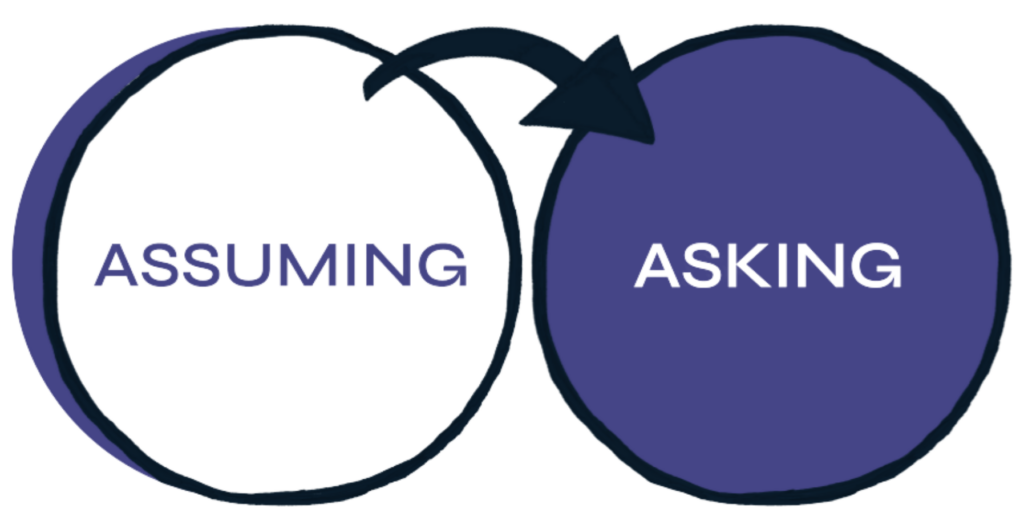
Ask what your students are experiencing, and approach their answers with curiosity.
From tech-centered to teen-centered

Lead with questions about your students’ values, strengths, vulnerabilities, and the pressures they face.
From us-vs-them to us-and-them
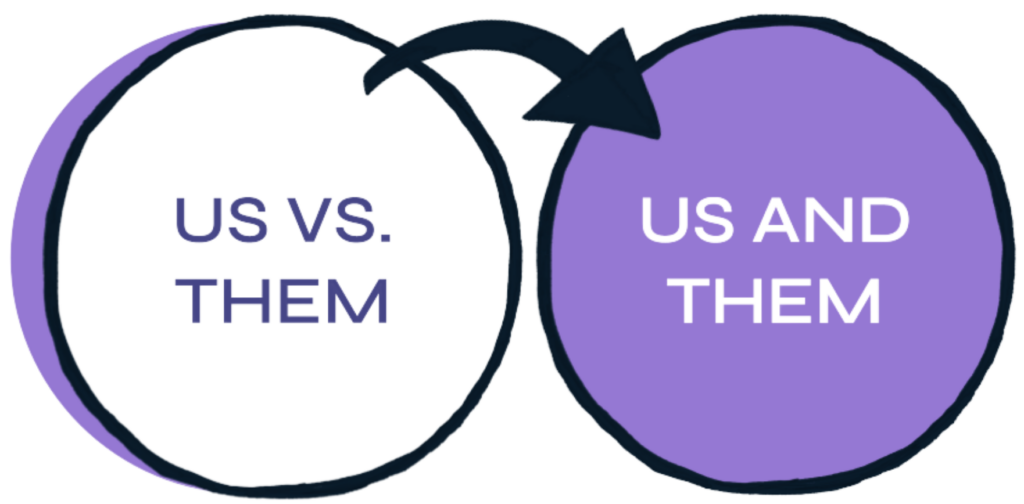
AI technologies are challenging for all of us. Reframing the conversation helps us connect over the struggle.
NAME TO CLAIM
This report features new that was co-developed with educators, youth, researchers, and technologists using the fifth play: Name the Game.
AI-DAR
/ˈāˌī dɑr/ n.
The perceived ability to detect when AI has been used.
CHAT·PLO·MA·CY
/CHatˈplōməsē/ n.
Using AI to soften tone, smooth communication, or make messages more diplomatic.
TWO-WAY SUS·PI·CION
/ˈto͞o ˌwā səˈspiSHən/ n.
When two parties both suspect each other of using AI, eroding trust regardless of whether AI is actually used.
WHY BOTH·ER·ISM
/ˈ(h)wī ˈbäT͟Hərˌizəm/ n.
The feeling that if AI can do a task, there is little point in learning or attempting it yourself.
“I don’t want to save the world. I only want to start a conversation.”
Maxine Greene, education philosopher
Educators don’t need to save the world from AI. Right now, they just need to start a conversation: with their students, and with each other.
EXPLORE MORE
COLLECTION
AI Literacy
The report, the plays, videos, and related research on AI and Agency all in one place.
FRAMEWORK
Agency-Centered Framework for AI Literacy
The framework underpinning all five plays.
PD COURSE · 12 HOURS
8 Mindshifts for Teaching Digital Well-being
Our self-paced course for educators, with new AI content.
Suggested citation: Tench, B., Weinstein, E., & James, C., with Starks, A., & Konrath, S. (2026). An AI Policy Isn’t a Playbook: Educators Need Agency, Not Just New Rules. Cambridge, MA, USA: Center for Digital Thriving. This report is part of IMAGINE (Inspiring Moral AI Guidance IN Education), made possible through the support of Grant 63220 from the John Templeton Foundation. The opinions expressed are those of the authors and do not necessarily reflect the views of the John Templeton Foundation. We are also grateful to the Susan Crown Exchange and Pivotal Ventures. Licensed under CC BY-NC-SA 4.0.